
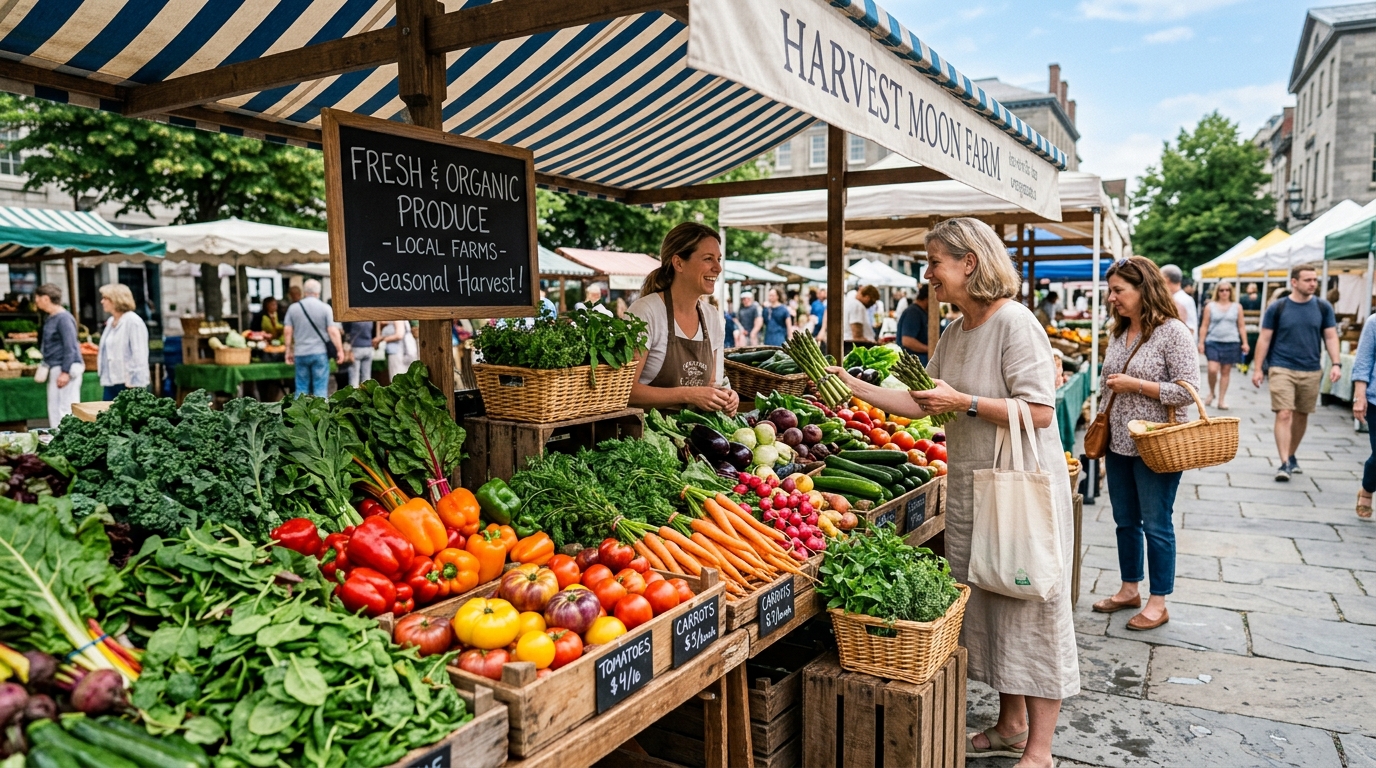
The alarm goes off at 4:15 on Saturday morning. By 5:30 you have the truck loaded with tomatoes, eggs, honey, and the last of your summer squash. You pull into the market lot at 6:45, unload under sodium lights, and start arranging wooden crates on a folding table while the coffee vendor fires up her propane burner. At 8:00 the first customers wander through. By noon you know whether this week was worth the ten hours of harvest, prep, load-in, and breakdown that got you here.
For more on this topic, see our guides on Farmers Market Sales, Farm Direct Selling.
Selling at farmers markets is the most direct path from soil to paycheck for many small farms. It eliminates the wholesaler, lets you keep retail margins, and builds relationships with the people who eat your food. It also demands skills that have nothing to do with growing vegetables. Pricing, display, marketing, cash flow management, and customer service all determine whether your market season ends in the black or leaves you wondering why you spent every Saturday away from the farm.
This guide covers the practical side of market success. Not the romantic version where customers fawn over your heirlooms and you sell out by 10:00. The real version, where margins are thin, competition is real, and the farmers who make it treat the market like a business, not a hobby.
Pricing Your Products for Retail Profit
The biggest mistake new vendors make is underpricing. They look at grocery store tomatoes at $2.99 per pound, calculate their cost at $0.80 per pound, and price theirs at $2.00 to move fast. That logic ignores the labor of harvest, wash, pack, transport, setup, and the six hours of standing behind a table. It also trains customers to expect cheap food from local farms, which hurts every vendor in the row.
Retail pricing at a farmers market starts with your actual cost, not your fantasy cost. Add up seed, soil amendments, water, fuel, packaging, market fees, and the hours you spend on every task from planting to teardown. Divide by the number of units you expect to sell. That is your break-even. Your retail price needs to be at least double that figure to cover the unexpected — a hailstorm that cuts yield, a slow week where you bring half of it home, or a customer who wants to haggle.
Break-even pricing is non-negotiable knowledge. If you do not know your cost per dozen eggs, per pound of carrots, or per jar of honey, you are guessing. Guessing leads to the common pattern where a farm works hard all season, sells everything, and still loses money because the numbers never added up in the first place. Financial literacy is as critical to farm profitability as knowing when to side-dress corn or prune tomatoes.
Premium products can command premium prices, but only if the quality justifies it. A dented tomato with soft spots is not a $4.50 per pound tomato no matter how good the variety tastes. Consistency matters more than peak perfection. Customers who buy your eggs every week need them to taste the same, look the same, and be available the same. One off week and they start buying from the farm three tables down.
Consider your positioning relative to other vendors. If three farms are selling head lettuce and yours is the only one using a specific heat-tolerant summer variety, that is a talking point built into the price. If you are one of seven tomato vendors and your tomatoes look identical to six other tables, price competition will drive your margin into the dirt. Differentiation — in variety, presentation, or story — protects your pricing power.
Building a Market Display That Sells
People shop with their eyes before they shop with their wallets. A display that looks like a garage sale tells customers you are disorganized, which translates to concerns about food safety and quality. A clean, vertical display with clear signage and logical groupings tells customers you run a professional operation.
Vertical displays sell better than flat displays. Use crates, boxes, or risers to create multiple levels. Put your best-selling item at eye level and within easy reach. Customers do not want to dig through a bin to find the good peppers. They want the good peppers in front of them, labeled with the variety name and the price.
Signage should be legible from five feet away. Handwritten chalkboard signs work if your handwriting is readable. Printed signs work if they do not look like they came from a generic template. Every sign needs three pieces of information: the product name, the price, and one detail that differentiates it. "Cherokee Purple Tomatoes — $4.50/lb — heirloom variety, grown without synthetic sprays" tells a customer everything they need to know in one glance.
Sampling is one of the most effective tools you have. A small cup of cherry tomato halves or a cracker with your pepper jelly costs pennies and converts browsers into buyers. The trick is to offer samples without creating a mess or a line that blocks the aisle. A clean cutting board, toothpicks in a small cup, and a trash bin within arm's reach keep the display professional.
Keep your table stocked. A half-empty table at 10:00 looks like you are almost sold out, which creates urgency, but it also looks like you do not bring enough product. The balance is to bring slightly more than you expect to sell and restock from coolers under the table when displays thin out. Nothing kills a farmers market table faster than a bare patch in the middle where the best produce used to sit.
The Numbers Every Direct-Sales Farmer Should Track
Running a market table without knowing your numbers is like driving without a speedometer. You might get where you are going, but you will not know if you are breaking the law until the lights come on. These are the figures that separate viable direct-to-consumer farms from operations that quietly bleed money:
- Cost of goods sold per unit — seed, amendments, water, and direct labor for each product you sell. If you do not know this to the penny, you cannot price accurately
- Total market cost per week — booth fee, fuel, packaging, ice, signage replacement, and your own labor hours at a realistic wage. Most farmers undercount labor by valuing their time at zero
- Average transaction size — total sales divided by number of transactions. A low average means customers are buying single items. A healthy market table pushes average transactions up through bundling and suggestion
- Sell-through rate by product — percentage of each product that sells versus comes home. Products with consistent sell-through above 85 percent deserve more planting space. Products that regularly come home at 50 percent need a pricing, placement, or quality adjustment
- Seasonal cash flow by month — income minus expenses tracked weekly across the entire season. Direct sales create feast-or-famine patterns that can hide losses until October when the bills come due
- Customer retention rate — rough count of repeat faces week to week. Markets with strong customer retention build stability. Markets where every sale is to a new tourist are unpredictable
- Time-to-dollar ratio — total hours spent on market activities divided by net profit. If you are making eight dollars per hour after all costs at a Saturday market, you need a different strategy, a different market, or a different product mix
These numbers do not require sophisticated software. A spreadsheet or even a ruled notebook works. What matters is that you actually track them, every week, without exception. After three or four weeks the patterns become obvious. You will see which products move, which markets are worth the drive, and where your time generates real return.
Social Media: Your Pre-Market Sales Engine
The best market vendors do not wait for foot traffic. They create it. Social media has become a powerful tool for rural community building and direct marketing. Farms with active online presences report stronger customer loyalty and higher sell-through rates than farms that treat market day as their only customer touchpoint.
The approach is simple. Post what you will have available before market day. A photo of crates loaded with fresh-picked corn, a quick video of hens in the pasture, or a text list of expected quantities gives regular customers a reason to seek you out. It also sets expectations. If you post that you are bringing twenty dozen eggs and a bushel of peaches, the customer who wants both knows to arrive early.
Consistency beats virality. One post per week with reliable timing builds more trust than a flurry of posts in July followed by silence in August. Your followers are not looking for professional photography. They want to see the farm, the animals, the plants, and the person behind the table. A shaky video of your dog in the squash patch builds more connection than a stock image of a farm at sunset.
Engage with other vendors and market organizers online. Tag the market in your posts. Share other farms' content when it is relevant. The farmers market ecosystem is stronger when vendors support each other, and cross-promotion introduces your products to customers who already buy local but might not know you exist.
Do not use social media to complain. Posting about slow sales, rude customers, or bad weather creates a negative association with your brand. Your online presence should make people want to visit your table, not feel sorry for you. If you have a genuine problem with the market or a customer, handle it privately.
Managing Seasonal Cash Flow on a Direct-Sales Farm
Direct-to-consumer sales through farmers markets and on-farm stores allow producers to capture retail-margin pricing rather than wholesale commodity prices. That margin advantage means nothing if you run out of cash in July before the heavy harvest months of August and September.
Seasonal cash flow gaps remain one of the biggest challenges for diversified small farms. Spring costs peak when income is lowest. Seeds, transplants, soil amendments, market fees, and equipment repairs all hit before the first tomato ripens. By June your checking account is thin. By July you are waiting for the Saturday market to cover the diesel bill for next week.
The fix is planning. Build a cash flow projection that maps every expected expense and income source by week from March through November. Start conservative on income and realistic on expenses. If your projection shows a negative balance in July, you know now that you need a line of credit, a part-time off-farm income source, or a planting adjustment that shifts some crops earlier.
On-farm sales can bridge the gap. A small farm stand at the end of your driveway costs almost nothing to operate and generates daily cash in July and August when passersby stop for tomatoes and corn. An honor system box with a lock and a price list works in rural areas where trust is high. It will not replace Saturday market revenue, but it smooths the weekly cash pattern.
Storage and value-added products extend your selling season. Freezing sweet corn, canning tomato sauce, or curing winter squash gives you products to sell in October, November, and December when fresh vegetables are gone and market season is over. A customer who buys your salsa at a holiday pop-up in December is a customer who will be back for tomatoes in July.
The Bottom Line on Farmers Market Strategy
The key takeaway is this: farmers market success depends on treating the market as a business function, not a side project. Pricing for real cost, building displays that convert browsers to buyers, tracking the numbers that matter, using social media to drive pre-market demand, and managing cash flow through the seasonal peaks and valleys are the practices that separate profitable vendors from exhausted ones.
Direct sales save family farms when they are executed with discipline. The margin is there. The customer base is there. The infrastructure is a folding table and a reliable truck. What is not guaranteed is the profit, and that comes only from the systems you build around the market table.
If you are ready to sharpen your market strategy and track the numbers that actually matter, visit bieldfarm.com for farm planning tools, financial templates, and the resources you need to turn every Saturday morning into a profitable operation.