
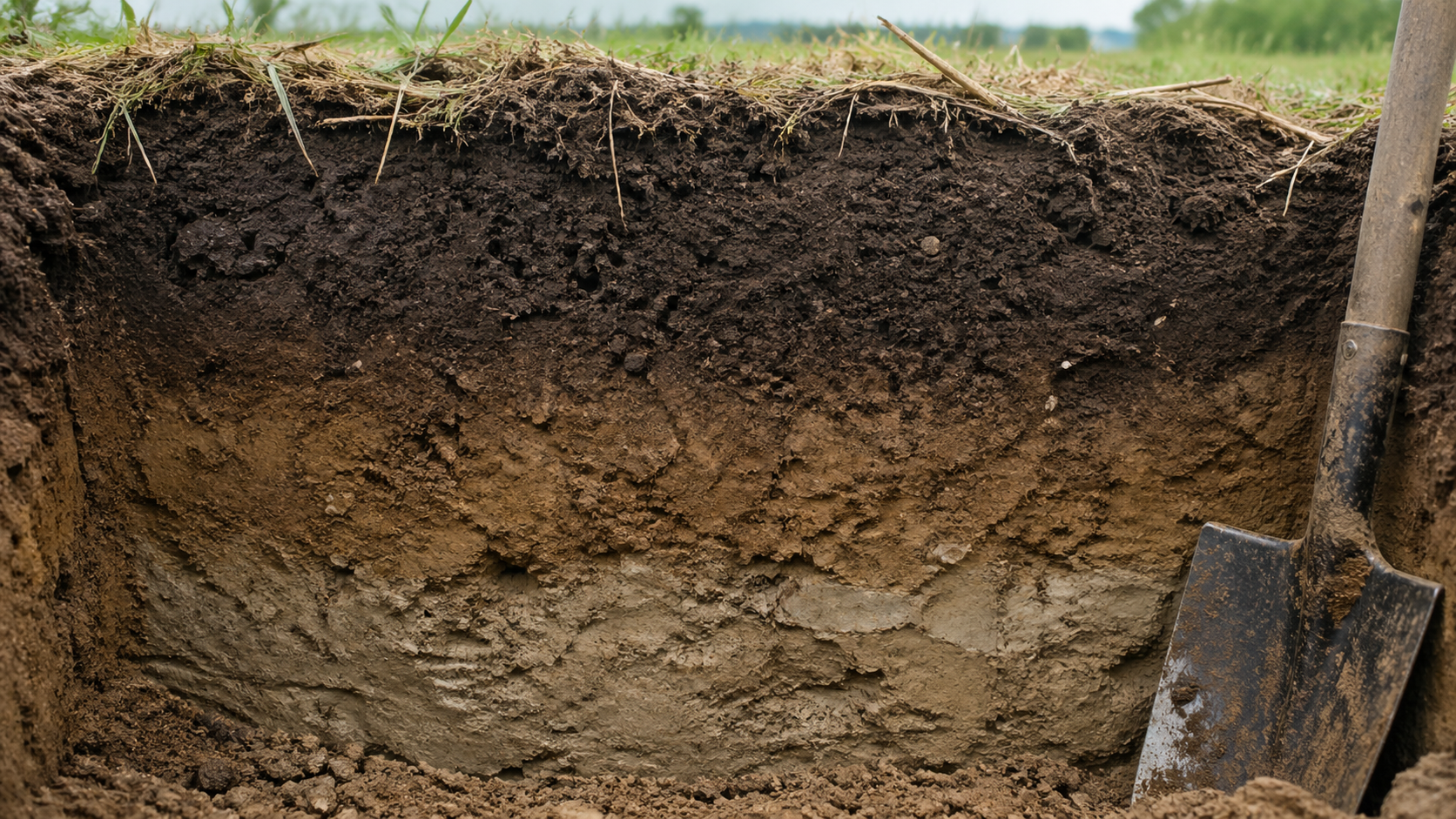
Most gardening failures are not pest problems or nutrient deficiencies. They're soil problems. A poor soil—compacted, airless, and lifeless—locks nutrients in forms plants cannot access and prevents water penetration. A carrot won't grow in hard clay. A tomato wilts in soil that doesn't hold water. A pepper develops blossom-end rot in calcium-deficient soil. These failures look like nutrient problems but are actually soil structural problems.
Building soil health is the single highest-impact practice available to gardeners. And it's also the cheapest. This article covers what organic matter does, why it matters, and the three-lever system that fixes nearly every soil problem without spending money.
What Organic Matter Actually Does
Organic matter is decomposed plant material—the humus in soil. It performs four critical functions in soil:
Improves physical structure: Organic matter creates aggregates—clumps of soil particles held together. Aggregates create pore space. Pore space allows water and air to move. A soil with 40–60% pore space is productive. A soil with 10% pore space is compacted and dead.
Increases water-holding capacity: Organic matter absorbs water like a sponge. Sandy soils, which drain too fast and can't hold moisture, become more retentive when organic matter increases. Clay soils, which hold too much water and become waterlogged, improve drainage as organic matter increases pore space.
Provides slow-release nutrition: Organic matter contains nitrogen, phosphorus, and micronutrients that are slowly released as microbes decompose the material. This is more reliable and stable than soluble fertilizers, which leach away.
Feeds microbial life: Soil is alive. Bacteria, fungi, and invertebrates break down organic matter, cycle nutrients, and create disease-suppressive compounds. A dead soil has minimal microbial activity. A living soil produces measurable earthworm activity, visible fungal networks, and disease suppression.
Symptoms of Poor Soil
A poorly structured soil shows specific symptoms:
- Cracked, dried surface in dry conditions (compaction preventing water penetration)
- Hard digging (poor structure, no aggregates)
- Wilting plants despite adequate water (poor drainage or water-holding capacity)
- Yellowing leaves in otherwise-adequate light (nutrient deficiency or pH mismatch due to poor soil biology)
- Blossom-end rot on tomatoes and peppers (calcium deficiency due to uneven water availability)
- Poor drainage; standing water after rain
- Pale, weak growth despite adequate light
- Weed dominance (weeds tolerate poor soil better than cultivated plants)
Any combination of these signals: your soil is the problem.
The Three-Lever System for Soil Improvement
Three practices, applied consistently, fix nearly every soil problem. They cost almost nothing, and they work everywhere.
Lever 1: Compost
Compost is decomposed organic matter. You can buy it ($30–50 per cubic yard delivered) or make it free. Spread 1–2 inches of compost on garden beds annually. Till it in lightly or allow it to work in over winter. Repeat every year.
This alone improves soil visibly over 3–5 years. More is not better—1–2 inches annually is the right rate. Overdoing it wastes money.
How to make compost free: collect yard waste, kitchen scraps (no meat), and leaves. Layer them 4:1 (brown:green). Keep the pile moist. Turn monthly if you want finished compost in 2–3 months, or leave it for 6–12 months and get finished compost with no work. Either way, compost costs zero.
Lever 2: Cover Crops
A cover crop is a plant grown to improve soil, not for harvest. Planted after harvest, terminated before spring planting, cover crops add organic matter and prevent nutrient leaching.
Winter rye is the standard choice. Plant it in fall, terminate in spring. A dense rye cover crop adds measurable organic matter in one season and suppresses weeds for the next season.
Cost: $5–10 per 1/4 acre for seed. No other input needed.
Lever 3: Reduced Tillage
Tillage (digging/turning soil) breaks soil structure. Every time you till, you destroy aggregates, disrupt microbial networks, and expose organic matter to oxidation—which burns it away. Excessive tillage is the single biggest cause of declining soil.
Solution: stop tilling. Instead, add compost on the surface and let it work in naturally. No-till gardens build structure faster than tilled gardens—counterintuitively, doing nothing beats working the soil to death.
If your soil is heavily compacted or already depleted, one year of tillage to break compaction is acceptable. Then stop.
Applying the Three Levers
Year 1: Spread 1–2 inches of compost. Plant a fall cover crop (winter rye).
Year 2: Terminate rye in spring. Spread 1–2 inches of compost. Do not till. Plant main crop. Plant a fall cover crop.
Year 3+: Repeat. Spread compost annually. Rotate cover crops (legumes for nitrogen, grasses for weed suppression).
No other inputs needed. No $500 soil amendments. No expensive fertilizers. Compost, cover crops, and no-till beat every commercial product available.
Simple Soil Health Indicators
You don't need a lab test to assess soil health. Simple observations work:
Earthworm count: Dig a 1-foot cube of soil. Count earthworms. Healthy soil has 10+ earthworms per cubic foot. Poor soil has fewer than 2. Increase compost and reduce tillage to increase earthworm populations.
Drainage: Pour water on bare soil. If it penetrates in under 5 minutes, drainage is good. If it takes 15+ minutes, structure is poor. Compost and cover crops improve this.
Digging ease: You should be able to push a shovel into soil with your body weight. If you need to stomp on it or jump, compaction is the problem.
Plant growth: Vigorous, pest-resistant plants in adequate light indicate good soil. Weak, yellowing plants in the same bed indicate soil problems.
The Timeline for Soil Improvement
Soil health building is not a one-season project. Expect visible improvement in year 2, significant improvement by year 3, and excellent soil by year 5. This timeline is realistic and achievable without expensive inputs.
The Midwest and most temperate regions can apply the three-lever system directly. Arid regions should prioritize water-holding capacity. Tropical regions with intense leaching should prioritize cover crops and frequent compost application. Regional variations exist, but the principle is universal: compost, cover crops, reduced tillage.
Getting Started with Soil Improvement
Start today by collecting compost materials or buying a load. Spread 1–2 inches on your garden beds. Order cover crop seed for fall planting. Stop tilling.
That's it. You've started. Do those three things consistently for 3 years and your soil will transform visibly. The difference between a first-year gardener's soil and a third-year gardener's soil using these methods is striking—from hard, airless clay to dark, crumbly, easy-digging structure.
Soil health is the foundation of productive gardening. Building organic matter through compost, cover crops, and reduced tillage is proven, cheap, and effective. Stop buying expensive amendments and products. Apply these three levers, give them time, and watch your soil come alive. Learn more soil-building techniques and amendment strategies at bieldfarm.com.